
What's your recovery plan?
- Tom

- Jan 5, 2025
- 3 min read
When people want to take their running up a level, most attention turns to the training plan - the workouts, the volume, the target paces, the races which, if you manage to do, will lead to improvement. However, this is based on a fallacy. The graphic below is something that really flicked a switch for me in terms of understanding how performance actually works.
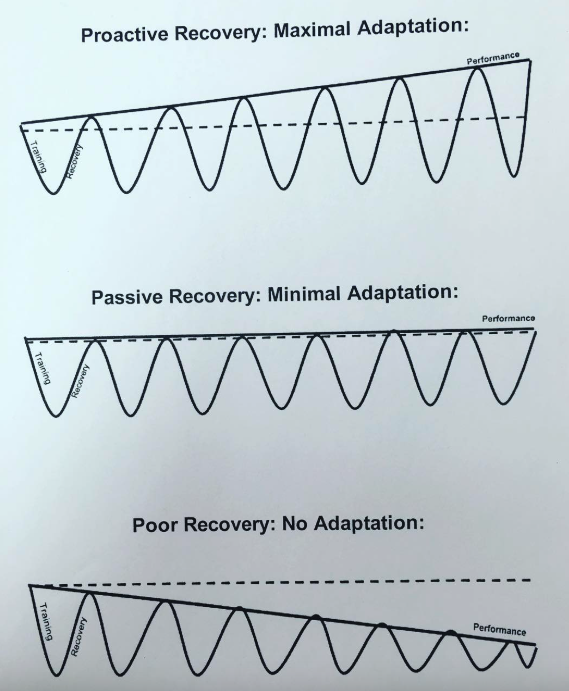
What you're seeing here is the relationship between training stress and adaptation. The top line shows what happens with proactive recovery - each dip (training stress) is followed by a rise that exceeds the previous level (adaptation). The middle line shows minimal gains with passive recovery, while the bottom line demonstrates what happens when recovery is neglected - a steady decline in performance.
Why this matters
When you run, you're not actually getting fitter - you're creating stress that your body needs to adapt to. The adaptation happens during recovery. Without proper recovery, you're essentially digging a hole that gets deeper with each training session. Everyone wants to crush their training, but for so many people they find themselves in that bottom line. The very best elite runners are master recoverers. They know how to absorb every session, every week of training and it’s the maximal adaptation to training that puts them on the level they are.
Defining recovery
Quite simply, it’s not adding to the stress your body is under as a result of your running workout. It’s giving it the time and space to repair and grow back stronger. This will of course depend on the level of stress. A big workout or hard race might require full rest for days and nothing more than walking as exercise. A smaller workout may only require a matter of hours.
Making it work
This isn't about complex recovery protocols or expensive gadgets. It's about being as intentional with your recovery as you are with your training. Some runners worry that focusing on recovery means training less hard. Actually, it means being able to train harder when it counts, because you're starting each session fresh rather than carrying fatigue forward.
If I had to identify two aspects of recovery where there is the most bang for buck, it would be the immediate period upon finishing a workout, and sleep. Eat something as soon as you can after every run, and rehydrate copiously. Personally any run over 10k I bring water with me so that I don’t plunge myself into too much of a dehydrated state during my run, meaning I am essentially kick-starting my recovery earlier.
You don’t need me to give you advice on sleep, just think about whether you’re getting enough, and what you can do to improve its duration and quality. If you get these right then you are 95% of the way to good recovery.
The bigger picture
Think about your own training. No session is in isolation. Your 6 x 1000 reps on one day may follow two days of other running, or you may have had two days’ rest prior. If you ran them at the same pace, you would likely be placing two different levels of stress on your body. Consider the load you’re carrying when you head into a session, and then also the recovery opportunity after it. If you are finishing up at home and can put your feet up for hours, this is an entirely different proposition than if you need to go to work immediately and are going to be on your feet a lot.
When I write training programmes, I can only do so much. I can set the sessions and space them out accordingly, but only you know the wider context. Don't just have a running training plan. Make sure you have a recovery plan too.


Comments